

Menu
Hiroshima, Nagasaki: never again!
See also women and the bomb
Hiroshima on August 6th - a city, a symbol, and a call to end the atomic age.
On the morning of August 6th, 1945, an unusual new kind of weapon was dropped on the city of Hiroshima. Three days later a second atomic bomb was dropped on Nagasaki.
See original photographs with information on the bombings of Hiroshima and Nagasaki.
August 6, 2007, in a report from Hiroshima:
..."In the Peace Memorial Park, close to ground zero of the blast, participants held a minutes silence at 8.05 local time when the B-29 Enola Gay bomber dropped the atomic bomb on Hiroshima, August 6th 1945. On that day 140 thousand people died. Only three days later another American plane launched a plutonium bomb on Nagasaki killing a further 80 thousand. Six days later Japan declared defeat.
Yesterday during a meeting with 7 groups of Hiroshima survivors, Premier Shinzo said repeatedly that Japan would stick to its self-imposed "three non-nuclear principles" banning the possession, production and import of nuclear arms, denying that the government would even debate a change in that stance. His declaration followed outrage over remarks by Japan's former defence minister Fumio Kyuma that had appeared to condone the bombings; Abe apologized on Sunday to survivors in Hiroshima over the comments and promised to review the government's tough standards for determining whether atomic bomb victims suffer from radiation disease, the subject of a series of lawsuits by victims. The initiative was applauded by all. Yet a portion of public opinion and some analysts judge the move “lacking in sincerity” and “without concrete guidelines”, seeing it as a means to regaining consensus following his party’s poor performance in Upper House elections.
The total number of Hiroshima victims recognised by the government is 253,008."
Source: www.asianews.it/index.php
August 6-9, 2005: the 60th Anniversary of the first use of atomic weapons against civilians. People and groups around the world marked the occasion with calls to bring an end to the nuclear age.
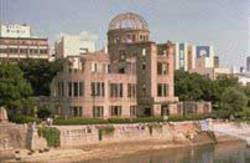
"The Hiroshima Peace Memorial (Genbaku Dome) was the only structure left standing in the area where the first atomic bomb exploded on 6 August 1945. Through the efforts of many people, including those of the city of Hiroshima, it has been preserved in the same state as immediately after the bombing. Not only is it a stark and powerful symbol of the most destructive force ever created by humankind; it also expresses the hope for world peace and the ultimate elimination of all nuclear weapons."
The International Physicians for the Prevention of Nuclear War IPPNW has launched an International Campaign to Abolish Nuclear Weapons (ICAN) to mobilize a groundswell of global support for the elimination of nuclear weapons by the year 2020.
Mayors for Peace:
"On June 24, 1982, at the 2nd UN Special Session on Disarmament held at UN Headquarters in New York, then Mayor Takeshi Araki of Hiroshima proposed a new Program to Promote the Solidarity of Cities toward the Total Abolition of Nuclear Weapons. This proposal offered cities a way to transcend national borders and work together to press for nuclear abolition. Subsequently, the mayors of Hiroshima and Nagasaki called on mayors around the world to support this program.
The Mayors for Peace is composed of cities around the world that have formally expressed support for the program Mayor Araki announced in 1982. As of May 26 , 2005, membership stood at 1,036 cities in 112 countries and regions..."
See which cities have signed on: North American cities
The Japan Council against Atomic and Hydrogen Bombs (Gensuikyo) was established in September 1955. Since then it has waged various kinds of campaigns for: the prevention of nuclear war; the total ban on and the elimination of nuclear weapons; and support and solidarity with Hibakusha (victims of the atomic bombing.)
The debate on why the bomb was used:
The myths of Hiroshima
By Kai Bird and Martin J. Sherwin,
(coauthors of "American Prometheus: The Triumph and Tragedy of J. Robert Oppenheimer")
..."The bomb was dropped, as J. Robert Oppenheimer, scientific director of the Manhattan Project, said in November 1945, on 'an essentially defeated enemy.' President Truman and his closest advisor, Secretary of State James Byrnes, quite plainly used it primarily to prevent the Soviets from sharing in the occupation of Japan. And they used it on Aug. 6 even though they had agreed among themselves as they returned home from the Potsdam Conference on Aug. 3 that the Japanese were looking for peace..."
Patriotic Correctness: the Hiroshima cover-up
"This article, which is drawn from the book, "Hiroshima in America: Fifty Years of Denial", shows how the media and government have covered up the full story of the U.S. atomic attacks on Hiroshima and Nagasaki in 1945, then and since. Lessons from this historic episode are applicable to the current "war on terrorism" even more so now than when the article originally appeared." (2002)
Hiroshima After Sixty Years: The Debate Continues
..."Did the atomic bomb, in fact, cause Japan to surrender? Most Americans think the answer is self-evident. However, many historical studies–including new publications by two highly regarded scholars--challenge the conventional understanding. In a recently released Harvard University Press volume drawing upon the latest Japanese sources, for instance, Professor Tsuyohsi Hasegawa concludes that the traditional “myth cannot be supported by historical facts.” By far the most important factor forcing the decision, his research indicates, was the Soviet declaration of war against Japan on August 8, 1945, just after the Hiroshima bombing..."
Brecht and the responsibility of the scientist
Women and Life on Earth-Southwest coordinator Constanze Frank speaks at the Upaya Zen Center in Santa Fe, NM. before the showing of "Fat Man and Little Boy", a film about the Manhattan Project.
Hiroshima: Was it necessary?
This site has many links and a detailed bibliography at:
http://www.doug-long.com/bibliog.
The Atomic Bomb - A Study of Aftermath
Lindsey Anhalt, December 2000
Hiroshima Archive
"Inspired by the photographic work "Hiroshima" by Japanese artist Hiromi Tsuchida, The Hiroshma Archive was originally set up to join the on-line effort made by many people all over the world to commemorate the 50th anniversary of the atomic bombing. The archive is intended to serve as a research and educational guide to those who want to gain and expand their knowledge of the atomic bombing.
Hiroshima Directory offers Internet resources as well as a selected bibliography of printed books, articles, and other research materials regarding the bombing of Hiroshima. Its main foci are history and the arts.
The Gallery shows poignant imagery from the postwar work "Hiroshima" by Hiromi Tsuchida, published with permission."